

Seagulls
The gull family comprises about 55 species. Most gull species live along coastlines. They are found almost worldwide, with the greatest diversity in the temperate and cold climates of both hemispheres. They usually begin breeding in their third or fourth year.
Ten species of gulls are found in Schleswig-Holstein alone. The most common gull species on the North Sea and Baltic Sea coasts and in Lower Saxony are the black-headed gull, the herring gull, the lesser black-backed gull, and, in smaller numbers, the great black-backed gull and the common gull.
Typical problems with seagulls include:
-
Hygiene and noise problems caused by nesting and droppings
-
Odor nuisance from the waste
-
High cleaning costs due to nests, droppings and feathers
-
Clogged drains due to nesting material and food scraps
Since gulls are opportunistic feeders, they have quickly learned that they can steal food from humans in urban and tourist areas and launch attacks on perceived food providers. (Unfortunately, this has often been initiated by feeding them.) If these attacks become excessive, appropriate deterrent measures should be implemented. During the breeding season, gulls sometimes attack people who they perceive as getting too close to their young.
Some species, such as the herring gull, have become synanthropic and populate favorable feeding habitats of all kinds, especially in winter, such as arable land, landfills, sewage treatment plants, settling ponds and fish or meat processing plants, as well as ports and waters in cities.

Herring Gull (Larus argentatus)

The most common large gull in Central and Northern Europe, along coasts and inland. Size approximately 65 cm, wingspan 1.55 m. The male herring gull is larger. Plumage: White with a pale grey back and wing coverts. A large yellow bill with a red spot (gony's spot) and pale pink legs. They have webbed feet! Egg-laying begins in mid-April and lasts until about mid-July. The clutch consists of 2-3 eggs. They feed the young gulls for about 50 days until they fledge.
Common Gull (Larus canus) (G)

It is widespread in northwestern and northern Europe. With a body length of 40-45 cm and a wingspan of 100-108 cm, it is slightly larger than a black-headed gull and considerably smaller than a herring gull. It is slender; compared to the herring gull, its head is rounder, its bill finer, and its wings narrower. It has a red throat, and its bill and legs are yellow. The common gull breeds in small colonies of up to 50 pairs, sometimes in larger colonies along the coast. The nest is usually built on the ground. It incubates two to three eggs.
Black-headed Gull (Larus ridibundus)
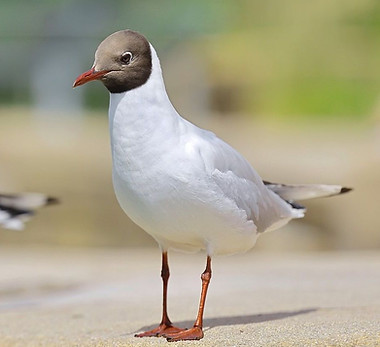
With a body length of 35–39 cm and a wingspan of 86–99 cm, it is the smallest gull that breeds regularly in Central Europe. It weighs approximately 300 g. Large numbers of them remain in Central and Western Europe throughout the winter. In summer, adult birds have a chocolate-brown head, a dark red beak, and red legs. They breed in colonies. More than 57,000 pairs are present on the German North Sea coast.
Mediterranean Gull (Larus michahellis)

At 52 to 58 cm in length and with a wingspan of 120 to 140 cm, it is smaller than the very similar Herring Gull. It weighs up to 1500 g. However, it is more robustly built, has a thicker beak, and a more arched head. It is long-legged, has yellow feet, and a red throat. Both sexes look alike; the non-breeding plumage shows brown streaks on the head.
Mediterranean gulls have migrated from southern Europe to Germany and have reached the northern limit of their current distribution in North Rhine-Westphalia.
Black-headed Gull (Larus melanocephalus)

It belongs to the gull family. It is found in Central Europe. It is a migratory bird and winters in the Mediterranean region. Its breeding grounds are located on coasts, at river mouths, in dune landscapes, and inland, such as in Hamburg. It has a white body, grey wings, white wingtips and tail feathers, and a black head extending to the nape. It has dark eyes with white eyelids, a bright red beak, dark red legs, and webbed feet. It is often confused with the black-headed gull.
Great Black-backed Gull (Larus marinus)

At 61–78 cm in length and weighing 1.5–2 kg, it is the largest bird species in the gull family. Its wingspan of 145–165 cm is relatively short, and in flight it resembles a white-tailed eagle. The plumage is slate-grey, and the feet are flesh-colored. They nest on rocky cliffs and incubate two to three eggs. The total wintering population in northwestern Europe numbers up to 480,000 birds.